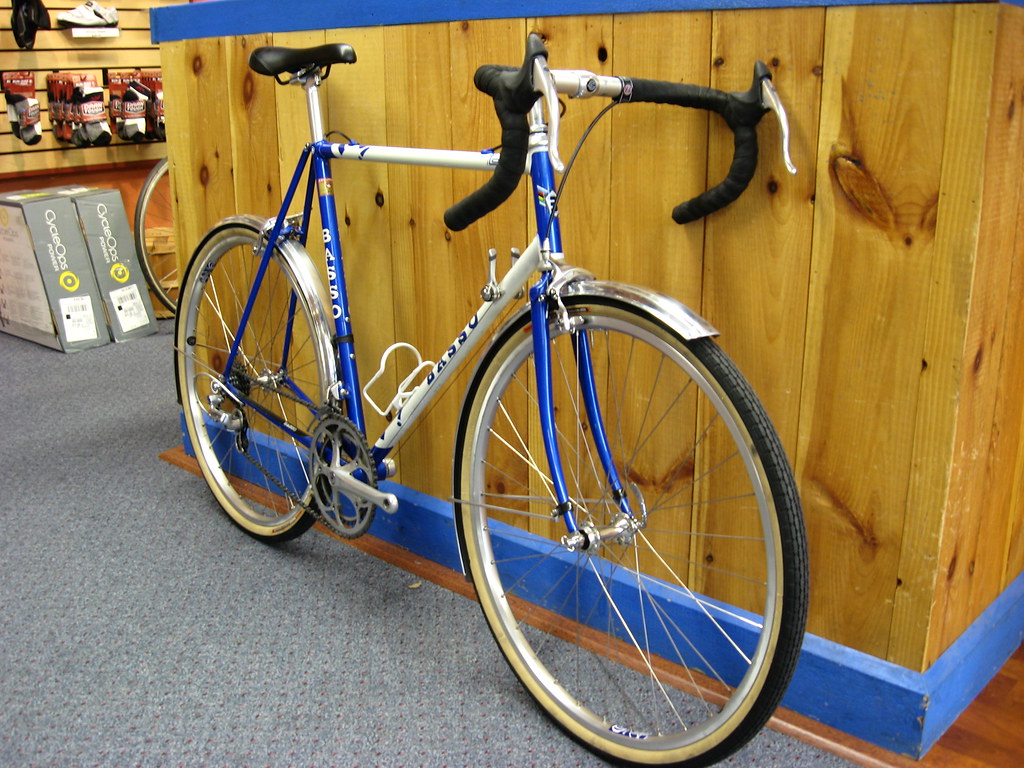
I'll get to the whole subject of the title in a second, but a note about the blog--for better or worst of my judgment, I loaned my camera to my friend who is currently sailing across the Gulf of Mexico from Florida to Guatemala, and seeing how that something I'd never do, I figure it'd be cool if he took pictures with it. See the world... Through other people. Anyway, no photos from for a while, so obviously I can't show you directly the cool stuff, but I'll use my words. Hard.
-----
Of the endless topics I prattle on about on the regular, low trail bikes are usually at the top for things I should try to cut back on. If you look at the picture above, 'trail' is neatly labeled right underneath the front wheel. It's measured by figuring out where the centerline of the steering axis is and where the the front axle is in relation to the ground. The overwhelming majority of modern bike today have mid to high trail because its believed to have smoother handling.
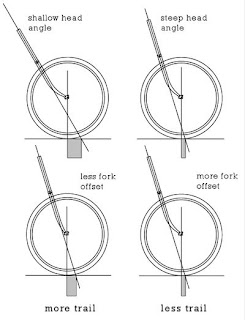
As the above picture demonstrates, there are two ways major ways to change around your trail. The first is by having a steeper or more shallow head tube angle. Head tube angle are usually around 69-75 degrees (and that's a pretty wide range), with 73 being a fairly common middle ground. The second way to alter trail is increase or decrease the 'rake' of the fork. Rake is measured by how far the axle of the front wheel is from the steering axis. Generally speaking, a fork that is bent to a greater degree has higher rake. By making the head tube a steeper angle and increasing the rake of the fork, trail is lessened. By making the head tube more slack and the rake smaller, trail is increased.
Another way to visualize trail is by looking at the bottom bracket (where the cranks are connected the bicycle) in relation to the front wheel. Generally speaking, the farther away the front wheel is from the bottom bracket, the lower the trail is. Thinking of it this way, a few benefits of low trail are illuminated. For instance, on smaller frames its a common problem where when the crank is at the 3 o'clock/9 o'clock position, the rider's foot will hit the front wheel when making an exaggerated turn. At high speeds, this make no difference as you'll never turn the front end enough during a turn to make a difference. But at lower speeds, it can cause a minor crash--something you don't really want in city traffic. Low trail geometry deceases the likely hood of this happening.
Another major benefit of low trail is the ability to hold a load on the front of the bicycle without sacrificing the handling of the bike at high speeds. With the wheel farther forward, a load above the wheel is better stabilized by having the wheel constantly guiding the weight instead of it being pushed by it. High trail bicycles also have a fair amount of 'wheel flop'. When the bicycle's front end is turned to the left or the right, the height of the front sinks a bit. This is a good thing, as it acts as a sort of 'power steering' for the bike. With a load on the front however, the 'power steering' effect is exacerbated, causing the bike to want to fall to the left or right. High trail bikes have more wheel flop than low trail bikes. Since low trail has less wheel flop, it can feel more 'twitchy' than high trail bikes, but its ability carry loads is improved, especially at higher speeds.
There are other benefits of low trail such as the bicycle's ability to 'hold the line' on turns. Since wheel flop is decreased, the rider is forced to have more control over the steering of the bike. This benefits the rider, as they are more able to control where the bicycle directs itself during a turn without resisting the 'power steering' as much. This can be particularly helpful for when biking quickly at night and noticing an obstacle in the road when its almost too late--your ability to correct and avoid is increased.
I think the Lovely Bicycle! blog had a good point in that low trail isn't 'life changing' so much as its just 'kinda nice'. It can change how you use your bicycle and make it better at doing that, but it also isn't a game breaker/winner.
----
It looks like I'll be getting a new fork for the big trash pile bike, giving it low trail geometry. Gonna get a handlebar bag and front rack too, so hopefully this will make my 'carry shit' dilemma a little better. As I mentioned in the last post, messenger bags, back packs, and panniers just don't suit going on longer rides in which I only need to carry the essentials. Kinda nervous, as it's going to set me back $300+ and I really should be budgeting more this season, but I'm a sucker for this kind of shit.
Because I'm a mega nerd, I have planned out everything I want to get:
Corey Thompson-made fork
VO Randonneur front rack and decaileur
Handlebar bag that is super tall made by a friend (Not many vegan options out there...)
1" Threadless. First threadless bike I'm going to own besides a MTB I crashed a long time ago.
VO 45mm fenders because I love metal fenders but can't afford non-outsourced bike parts...
30mm Challenge Paris-Roubaix tires, or 32mm Grand Bois Cypress (700c!)
VO Grand Cru standard reach dual pivots (damn you globalization.)
I also really want to get Grand Bois Maes Parallel bars, but I have no money for anything above listed, much less $90 handlebars. I have these old school Campy Nuovo Record non-aero levers that I think I'll use. If I don't like those, then I might splurge for those sweet TRP aero levers. Some other cool free-bee parts I got are a Nuovo Record rear derailer and a Shimano 600 corn cob 6 speed freewheel. I found these shit 700c wheels that I revived, but it'd be cool to get something more legit in the future, primarily a generator hub.
The sad part of this is that I'm going to part out the Lotus to complete this project, taking away the cranks, bottom bracket, front derailer, shifters, saddle and maybe handle bars... I think I'll make it a fixed gear as I kinda miss having one around and I still love the frame, but one project at a time. FUCK MONEY. Does anyone want to pay me to be a nerd AND let me stay in Olympia? Because I'm willing.